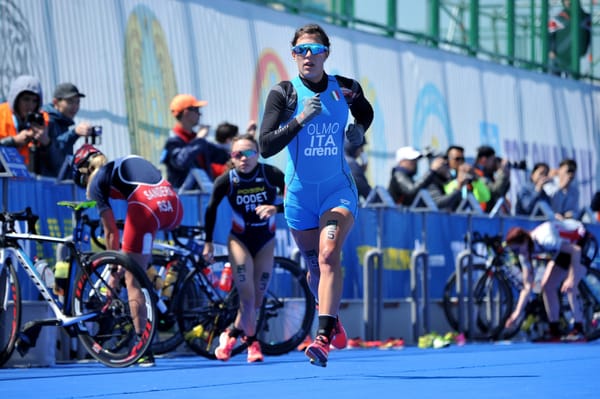
Running while fatigued is a different beast to running fresh, and gaining bike strength has an immense impact on how fast you can run in a triathlon.
One of my early triathlon coaches, in fact, my only triathlon coach, Col Stewart once said that the key to running fast in a triathlon is to become a stronger cyclist. This made no sense at all to a 19-year-old triathlete who would kill himself trying to run sub three-minute kilometres every session.
It only really started to make sense as I transitioned into long course in my early twenties. I spent a lot of my professional triathlon career racing the tough, hilly French triathlon circuit where you were tested on just about every course with big hills, fast descents and riders who could push enormous watts. I came home from each French season really strong on the bike, which was made more apparent racing on the flat Aussie courses, and this, in turn, affected how fast I could run.
It was then I began to think about ‘triathlon running’ as opposed to ‘fresh’ road running. Running while fatigued is a different beast to running fresh, and gaining bike strength has an immense impact on how fast you can run in a triathlon.
Finding your pace
One of the keys to running fast in triathlon is finding your ‘happy place’. This doesn’t mean eating magic mushrooms from the roadside and dancing through the marathon. It means training for your fatigued running pace and learning to run at this pace all day so it becomes automatic during your hard sessions. If your goal half-ironman run time is four-minute kilometre pace, then that is the pace you should be aiming for during your hard sessions.
Athletes often overlook this, especially when you break this pacing down into 400-metre or kilometre reps, as running this pace when not fatigued can seem quite slow. But, the idea is to become a metronome at this pace whether fatigued or not. A good way of utilising fatigue in training is to implement a double run day with a longer easy run in the morning and then a faster fatigued-state run aimed at hitting your goal pace later on in the day. This will not only break up your long run day and reduce the load on the body; it will also induce fatigue on the legs similar to that of a half ironman.
Brick sessions
As I touched on before, increasing your bike strength can be of immense benefit to your run times in a triathlon, and the best way to do this is to trial it in your weekly or fortnightly brick session. Try and find a 30-to-40-kilometre TT course that’s hilly and hard so it tests the legs out. Then find a 30-minute run TT route you run off the bike also at threshold pace. Once you have implemented your PB times, you can revisit this session once or twice a month and experiment with exertion levels. This is where power meters are a great tool as coaches can set power limits and see how these affect run times. Ideally, with some extra-specific bike work, you should aim at hitting your PB bike time easily but remain much fresher running off the bike. This should subsequently see you travelling faster over your TT course.
Leg strength
Increasing leg strength to deal with a hard bike ride will have great benefits for your run when racing. There are a few ways to do this and one is to set up a good base of hill riding. Just tempo hill riding mixed in with some strength efforts will give you a great foundation when you start to hit specific fast sessions later on in the year. Seated hill reps in a big gear once a week will activate the critical bike muscles needed to push power and run off the bike a lot fresher. You can also activate these muscles by hitting the gym a few times a week and concentrating on hamstrings, glutes and calves. When these muscles are stronger it not only increase strength but also reduces injury as you have reinforced the essential ligaments and tendons associated with these groups. After a big winter base of strength work, you will be amazed at how much better you’ll run off the bike.
Racing
Pacing in a race is crucial when it comes to running well as power placed in the wrong zone at certain times in the race can come back to bite you in the run leg. This is also why power meters are a great tool for racing as well as training. Once you have set in place your power zones, you can be 100 per cent confident of the time you’ll be able to run off a certain power output as you would have played around with these numbers in training. If you don’t have a power meter, your next best measuring tool is your HR monitor coupled with feel. So, set in place some HR limits that you have used in training and be confident that you can run at your goal pace off this HR on the bike leg. Sure, you are going to nudge close to and sometimes over the limit in a race, as we are all human and our competitive nature can take over, but as long as you have a set limitation in mind to turn back to – especially when running off the bike – you’ll give yourself the best chance of an optimal performance.